Showing posts with label Honda. Show all posts
Honda EV-N concept


The EV-N is one of several new vehicles Honda showed off at the 2009 Tokyo Motor Show. In fact Honda was the manufacturer with the largest display at the event.

The EV-N is an all-electric vehicle which features a roof covered in solar panels to help top up the onboard battery. The Vehicles simple retro styling was inspired by the Honda N360, an ultra-compact micro car Honda released in the 1960s.

One of the more unusual aspects of the Honda EV-N is the integration of a Honda UX-3 personal mobility unicycle into the passenger side door panel.

Unsurprisingly the Honda EV-N is purely a styling exercise, and Honda developed the car with no plans to put the vehicle into production.
Honda P-NUT concept


The Honda P-NUT (Personal-Neo Urban Transport) concept is a bizarre and rather ridiculous concept which was displayed at the 2009 LA Auto Show. The design is a proposal for a futuristic three-seat vehicle for the city which offers a small physical and environmental footprint.

According to Dave Marek, director of advanced design for Honda R&D Americas: "A new generation is discovering the benefits of living in urban centers that provide convenient access to business, entertainment and social opportunities. The Personal-Neo Urban Transport concept explores the packaging and design potential for a vehicle conceived exclusively around the city lifestyle."

The unusual, but at the same time rather unimaginative shape and styling of the P-NUT was designed to offer a balance of eye-catching lines and maximum interior space. It certainly is eye catching - but for all the wrong reasons.

The layout of the interior, with its center driving position flanked by two rear seats, provides a decent amount of legroom for all three occupants. Interior functionality is increased by rear seating areas that fold up and out of the way to increase storage capacity. The windshield serves as a heads-up display for the navigation system and the back-up camera.

The modular rear engine bay of the P-NUT, depicted on the exterior by blue composite material, is designed to accommodate a wide variety of potential drivetrains, including a conventional small displacement internal combustion engine, a hybrid gasoline-electric powertrain, or a battery-electric powertrain.
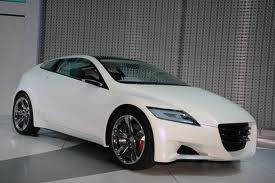
Honda CR-Z 2011 concept


The Honda CR-Z combines the advantages of a clean, efficient petrol electric hybrid powertrain with a 6-speed manual transmission and a stylish coupe body. With a 2+2 coupe form, this new CR-Z will change current perceptions of hybrids, with its driver-focussed chassis and 1.5-litre engine. For the first time, a fuel efficient, low emission parallel hybrid system is combined with an ultra precise 6-speed manual gearbox.
Honda V4 concept


It’s amazing now seeing the jaw dropping designs and concepts that Honda brings forward. Honda V4 concept has come up with a deadly sports bike that proposes a new bike design direction for the brand. This model is designed to indicate the beginning of a new era. The bike has V4 engine and it is clearly shown in the design. The hubless wheels are fixed with all-enveloping cowls which most likely assist in reducing drag. This stylish and futuristic sports bike concept was exposed at the 2008 Intermot bike show in Germany. Overall, this bike is going to offer a new look to all the bike riders with excellent performance.
Honda Skydeck concept


The Honda Skydeck Concept - a concept that will be unveiled at the 2009 Tokyo Motor Show - is an innovative 6-seater hybrid MPV. It features sliding and scissoring doors that reveal a passenger cabin that is minimalist and futuristic.
To give the Honda Skydeck Concept the practicality of a conventional MPV, many of the hybrid system components - including the high power battery - are housed in the car's centre tunnel (rather than behind the rear seats or under the floor, as with previous production hybrids). This allows for greater cabin space, and the room for three rows of two seats. It also gives a lower centre of gravity.
Honda 3R-C concept


Honda 3R-C Concept, a revolutionary three wheeled battery electric vehicle concept, shows what a future minimal urban transport vehicle for one person might look like. The battery electric drivetrain is mounted low in the three wheeled chassis, therefore keeping the centre of gravity low and thus improving stability.

The Honda 3R-C Concept has a clear canopy that covers the driver's seat while it is parked and not in use. When 3R-C vehicle is in motion, the canopy becomes an enveloping wind-shield that provides the pilot, who sits low in the vehicle, with significant protection from the bodywork and doors.

The high sides of the safety shell seat give greater safety to the occupant, reducing the threat from side impacts and improving weather protection. In front of the driver is a lockable boot area, which gives significant secure storage for luggage or other items. The Honda 3R-C Concept's designers created a flexible cover that surrounds the upper torso to reduce exposure to bad weather and improving comfort.

The Honda 3R-C Concept study was created by European designers working at Honda's Research and Design facility in Milan.

Honda U3-X concept


The UX-3 is an absurdly bizarre contraption which Honda has devised in order to evaluate a completely new form of transport.

The UX-3 is an experimental technology at the moment, but Honda intends to continue research and development of the vehicle, including testing in real-world situations, to confirm the practicality of the technology.

Despite the fact the Honda UX-3 makes the driver look like a complete idiot, it does feature some pretty impressive technology within its sleek bodywork. Namely Honda's omni-directional driving wheel system (HOT Drive System) which enables movement in all directions, including right and left and diagonal, thanks to many small, motor-controlled wheels that are connected in-line to form one large-diameter wheel. By moving the large-diameter wheel, the device moves forward and backward, and by moving the small-diameter wheels, the device moves side-to-side. Combining these movements allows the UX-3 to travel diagonally too.

The design of the Honda U3-X has been developed to help the user interact with people around them. Unlike many other forms of personal transport the UX-3 places the rider at roughly the same eye level as pedestrians. So instead of looking down on them from a Segway, or up at them from a Toyota i-Real, they can talk face-to-face.

The system which balances the Honda UX-3 is derived from the balance unit found in Honda's ASIMO robot. Honda's balance control technology enables ASIMO to stand, walk and run in a controlled manner. This technology has been developed for the U3-X – to detect a shift in the rider's bodyweight to adjust the direction and speed of the device. Based on the incline sensor data, precise control is applied to return the device to an upright position, which achieves smooth and agile movements and simple operation using weight shift only.

The Honda U3-X has a lightweight monocoque body, with the foldable seat, footrests and body cover housed within the body of the device, making it highly compact, portable and convenient. Weighing in at less than 10 kgs (22 lbs) the Honda UX-3 features a lithium ion battery which offers up to 1 hour of operation with a full charge.
Honda Zeppelin Luxury Sports Sedan Concept


the Honda Zeppelin, a luxurious futuristic sedan car this splendid car was partially inspired by airships. The mass impression of this car was achieved by combining soft volume elements of an airship and potent lines that are commonly found in luxurious automobiles. The symmetric styling of this Honda Zeppelin is an extraordinary feature which can run from the hood, down the roofline and the entire rear end. Slit-like windscreen is another exclusive feature of this car. There is an inclusive video display inside the car which will allow the driver a greater field-of-vision.

The 2030 Honda’s luxury sports sedan, Zeppelin Concept, was designed with a design direction of “High-tech Dynamic”, inspired from an airship. The feeling of mass has been completed by applying design elements of aerodynamic form from an airship, and on top of that, expressed the distinct powerful image of Honda. Especially the asymmetrical main character line extends from the front hood along the roof line, to all the way back at the rear end. Hexagonal front grille and thick nose volume and the protruding horizontal lamp completes the dynamic face.

The interior was also inspired from the airship, reminiscent of a cozy salon or a first-class seat of an airplane. There is no dashboard in Zeppelin. All the necessary information and other elements needed for driving is displayed on the inter panel of the car, and everything is controlled with only the minimum physical movement due to the use of voice recognition technology. The seat position can be changed freely. That front row seat can rotate 360 degrees and so when the car is not moving, the front row seat and the back row seat can face each other. This makes it possible for a brief meeting, enjoying tea and even working in the car, which could also provide a new experience to the family or a fellow passenger. Due to the display environment on the windshield it was possible to use the angle of windshield and the shape of the A-pillar as a design element of the exterior without any restriction.
Honda Great Race concept


Honda's The Great Race 2025 concept was created for the 2008 LA Auto Show Design Challenge.

The whole idea for the concept revolves around the great race in 1908, when 17 men dared to take on the "toughest race ever devised." Spanning six months, the Great Race brought these men over 22,000 miles, through three continents and around the world.

The Honda concept is designed to act as a vehicle to fulfill all the demands of a similar race in 2025. Competitors must circumnavigate the globe in 24 hours on land through the United States, by sea through Asia and by air over Europe.

The vehicle's sonar/echolocation sensors are able to detect changes in speed, terrain, and altitude, allowing it to switch to any configuration. With experience in automotive, marine, robotics, and jet technologies already in place, Honda envisage a future vehicle in which any one of these areas can be conquered.
Honda Helix concept


For the 2009 LA Auto Show Design Challenge the competition was to design a vehicle for 2030 which would appeal to younger consumers. However judging by some of the theoretical technology Honda have bundled into the Helix concept they've designed a vehicle for 3030!

Advanced adaptive polymers, capable of shifting shape, color or even material properties, when coupled with the user's genetic code (DNA), will allow a vehicle to not just function as transportation, but rather be an extension of the user, evolving in parallel with the user throughout his or her life. Ownership will become more about the fulfillment for the driver through time and less about fulfillment of a product's lifespan. The longer the vehicle is with its owner, the more time it has to evolve to meet the user‘s needs, and ultimately form a unique singular bond between both human and machine DNA.

The Honda Helix is a multi-configuration vehicle which can be used in a variety of ways to suit the road conditions. These configurations are labeled A, B and Z.

A" is short and wide for cities that have very tight and intertwining road systems, where agility and speed allow a vehicle to more easily navigate chaotic traffic patterns. "B" is long and low for the sprawling cities of the world, where large distances allow for high speed travel. "Z" is tall and thin for congested cities of the world, where seating occupants vertically on two levels has the most volume per minimum footprint of any vehicle.

By using flexible and transforming multi-functioning parts, the Helix adapts and reacts to specific environments and traffic patterns by changing the orientation of its main capsule for optimal environmental operation and user functionality. Bio-receptors allow the vehicle to micro-adjust even further to meet the exact demands of the user and the environment. The direction of movement stays constant no matter what conformation the vehicle assumes.

The Honda Helix is a vehicle capable of adapting, evolving, and conforming to user needs anywhere in the world. Using insight gained from the human genome, biotechnology, and environmental forecasting, the Honda Helix will actively and dynamically conform to the user's needs, in environments ranging from the congested skies of Japan, to the wide open roads of America.